U.S. Navy Successfully Defends Nation From Unauthorized Cocktail Sauce
By Lenore P. Glumworth, DDS (Locked Bathroom Stall) — Tue, 21 Apr 2026 04:05:53 GMT
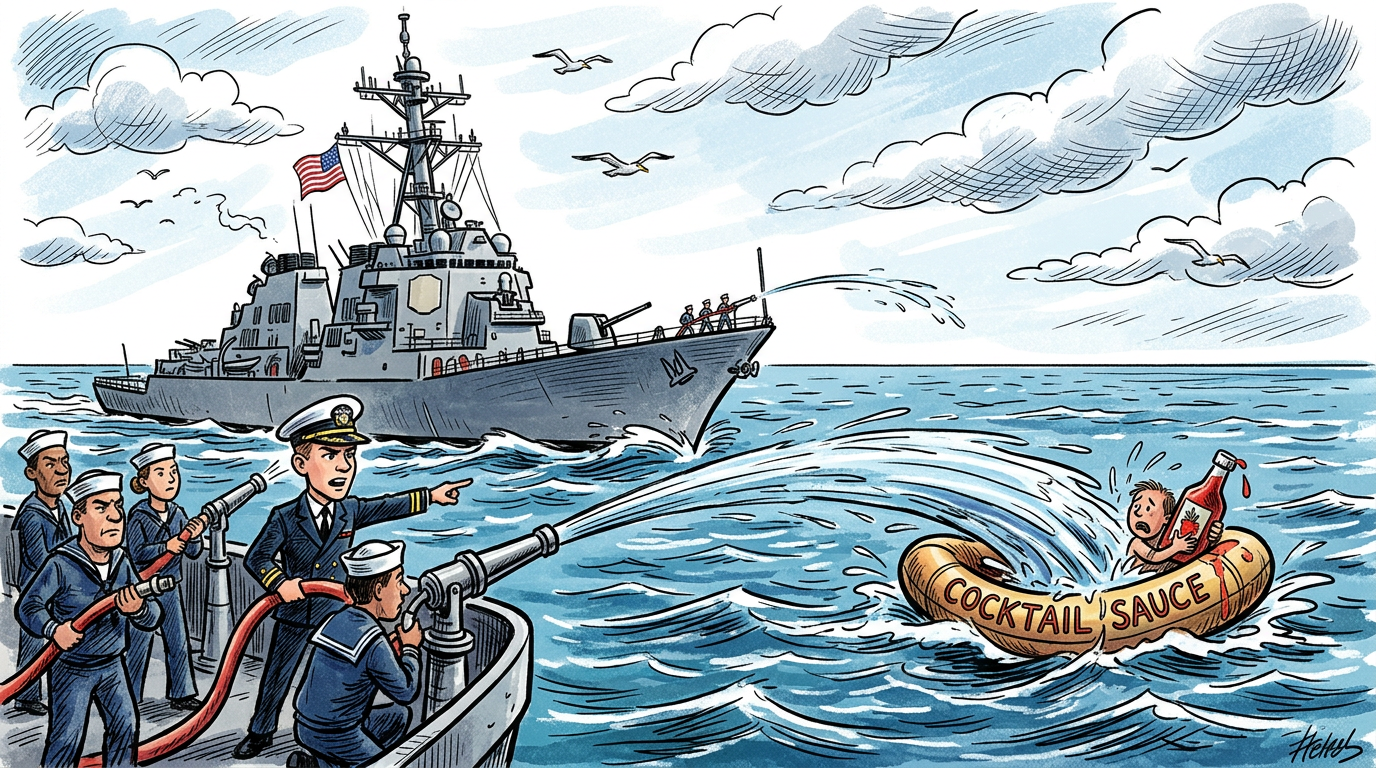
In a decisive test of new blockade protocols, a U.S. destroyer precision-targeted a vessel's industrial deep fryer, citing the 'suspiciously high density' of its seafood selection as a direct threat to national security.
"The intelligence was clear: the shrimp scampi was arranged in a hostile, offensive formation." — KEY SLUDGE FINDING
In a maneuver the Pentagon is hailing as a ‘successful kinetic audit of supply-chain vulnerabilities,’ a U.S. Navy destroyer today fired a high-velocity tungsten rod not at an Iranian warship, but directly into the Grand Neptune cruise liner’s ‘Treasures of the Sea’ all-you-can-eat buffet. The strike, occurring in the placid international waters of the Arabian Sea, instantly vaporized two metric tons of Alaskan king crab legs and a newly installed chocolate fountain.
The incident has been described as the first real-world test of the Navy's controversial 'Sniff & Strike' protocol for managing potential blockade runners. Rear Admiral P. Montague Crust (Ret.), now a Senior Fellow at the Institute for Applied Maritime Force, defended the action as a flawless execution of deterrence theory. “Let one unauthorized shipment of tartar sauce through, and you’re signaling to aggressors that our arteries are wide open,” Crust stated during a press conference, while pointedly applying a thick layer of butter to a brioche bun. “Our thermal imaging detected dangerously unregulated levels of butterfat and a shrimp cocktail arrangement that was… provocative.”
Survivors, primarily disillusioned members of the Grand Neptune’s culinary staff, offered a different assessment. “They bypassed the bridge, ignored the engine room, and used a billion dollars of taxpayer-funded technology to torpedo the soft-serve ice cream machine,” reported one sous-chef who wished to remain anonymous. “For three miles in every direction, the ocean now has the exact aroma of a Cheesecake Factory that just lost a brief, violent argument with a photon torpedo.”
This sentiment was not shared by Admiral Chip Saltwater, the freshly appointed commander of the Navy’s new Maritime Culinary Threat Division. Standing before a grim-faced press corps, Saltwater provided the core intelligence that justified the strike. “We can’t get into sources and methods,” the Admiral said gravely, “but the intelligence was clear: the shrimp scampi was arranged in a hostile, offensive formation.”
The State Department has since issued a memorandum clarifying that ‘proactive culinary de-escalation’ does not violate international law, provided the food items in question are deemed ‘suspiciously succulent.’ In response, the Navy has mandated that any vessel operating within a 500-mile exclusion zone must now submit a full manifest of all appetizers and dessert items to CENTCOM for culinary threat-assessment no less than 90 days prior to departure.
At a White House press briefing, Press Secretary Karine Jean-Pierre pushed back on the notion that the strike was a mistake, instead characterizing it as a “necessary recalibration of our strategic posture against non-state actors with access to industrial deep fryers.”
The owners of the Grand Neptune, a Liberia-based hospitality conglomerate, have filed an official grievance with the United Nations. They are requesting reparations in the form of 40,000 replacement spring rolls, 800 gallons of clarified butter, and a formal, handwritten apology from the Joint Chiefs of Staff on the back of a cocktail napkin.